Summer School 2025. Driving innovative governance: a lever for viable business models and a liveable world
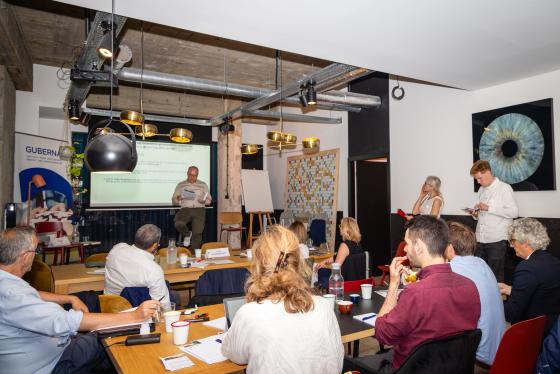
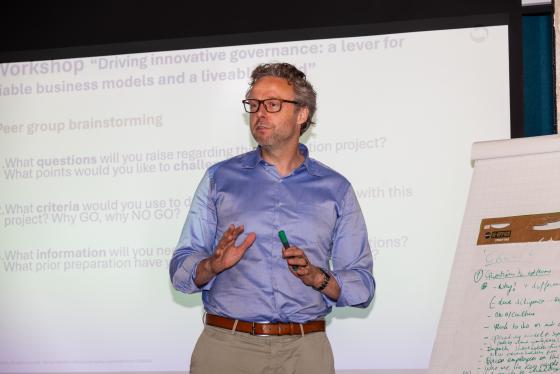
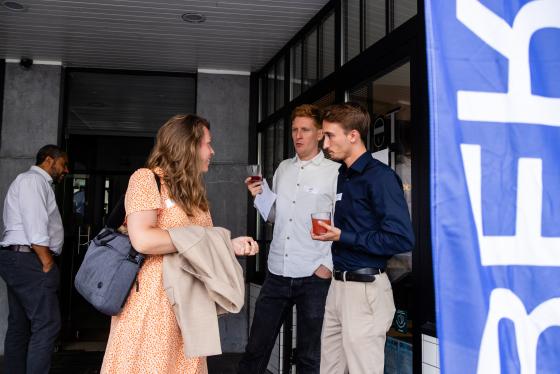
On the 26th of June, GUBERNA organised its Summer School 2025, addressing hot and provocative topic: “Driving innovative governance: a lever for viable business models and a liveable world”
Rachel Feller, GUBERNA Lifelong Learning Manager, warmly welcomed speakers and participants, promising original and inspiring insights throughout the day. She highlighted some of the paradoxes that remain, that the day was designed to explore, such as the simplistic division that still reigns between environmental (E) and social (S) issues, between our documented level of knowledge and the lack of action, when there is only one system on which our prosperity and survival depend: the living system.
The first speaker, Thomas Breuzard, major family shareholder and director in the Norsys Group, a large digital services company, stressed the need for a change to remain profitable in the rapidly evolving business environment. He shared the norsys’ permabusiness model (the so-called Permaentreprises model”) which unites business and societal challenges and is applied through three ethical principles:
Preserving the planet,
Setting limits and sharing wealth,
Taking care of people.
Permaentreprises do not renounce growth or value creation but change their conditions, aiming for fair, sustainable growth by putting CSR at the heart of the strategy. Indeed, 48% of Norsys’ business is in healthcare, social protection and the ecological transition. The company promotes development on a human scale through an archipelago of SMEs. It invests into renewable energies, finances decarbonisation and natural resource regeneration projects. Trough the norsys Foundation, 53.3% of pre-tax profits are redistributed to civil society. The norsys Foundation has been supporting associations since 2001; endowment fund was established in 2022 to finance ethical digital players.
Besides, norsys actively experiments with the role of nature in its governance. The company recently granted 10% of its shareholding to Nature and appointed a representative on Board with voting (and veto) rights on strategic projects.

Frantz Gault, a member of norsys Group Board of Directors and Nature's representative, brought different, often provocative, perspectives on how such an abstract entity as “Nature” could be actively present in Board decision-making. He therefore envisaged 3 scenarios:
Bio-centrism that gives value to every living organism. This is not a common way due to its non-conventional character: entitle animals and plants to similar rights as humans, including social security, remuneration, retirement, union representation to negotiate their interests, etc., may seem surprising; but it is already a reality in some countries such as New Zealand and Switzerland.
Within this approach the issue of consent becomes critical: where to put a borderline between waged labour and slavery.
Besides, rights of Nature imply also duties and responsibilities – is it possible to ensure those in the case of Nature?
Nature as an eco-system is a common scientific way to represent something huge compared to a single living organism. However, there is no way to interact with an abstract term. Thus, in this approach, Nature could be treated as a stakeholder, and as such be represented in government bodies. Concepts like Gaya or Mother Earth fall into this too general and too abstract category.
Who is legitimate to represent Nature in this case? Representation expects certain interests to be represented, they have to be specified. Political science distinguishes two types of legitimacy: general enabled through people votes, and substantial legitimacy, based on expertise and thus on formal features such as degrees, skills, experience.
Totemism lies in between the above-mentioned approaches. It relies on a concept of a family that includes humans and non-humans. This approach refuses the notions of ownership: you do not own your family, you belong to it. Within this perspective, companies should not own Nature, it is not a commodity. Stewardship movement falls into this category as it questions the existing ownership structure. However, the concept of consent of Nature remains too vague to be included into the existing legal framework.
Frantz also pointed out that the impact on the 9 planetary boundaries could be integrated into a perma-business model as a compass for reasonable limits.

Eloi Laurent, Professor of Economics, working at OFCE at Sciences Po, Ponts Paris Tech and Stanford University, started with stories illustrating the need for an economic shift and with reference to the current heat waves and their harmful effects on health (those who die are the elders and the most isolated).
He argued that full health can be a more relevant compass compared to the pursuit of GDP growth, which is ultimately destructive and counter-productive, when considering the increasing inequalities and massive pollution. Using reasoned and objective data, he called for a new social-ecological approach putting the well-being economy as a goal, and social justice as a driver for just transitions. He linked the concept of economic growth with the increasing inequality and pollution. He provided the data illustrating the empirical reality: for example, responsibility for climate change lies not on the humankind in general but on its wealthiest part that relies on the expanding model of economic growth as the imperative for business activity.
The richest 10% of human population are responsible for 52% emissions, while 50% of humans are responsible for 10% of total emissions, and already respect Paris agreements.
50% of the total CO2 emissions have been added since 1990s, i.e. within last 35 years. As another half has been generated since early 19th century, i.e. within 200 years, we observe extreme acceleration of CO2 emissions that destroy the environment we have been used to.
Twin crisis of inequality and sustainability leads to crisis of democracy that we need to start handling to avoid further and deeper crises.
Thus, Prof. Laurent called for reviewing the growth imperative and suggested well-being economy as a new economic framework that will balance contradictory interests.
When it comes to supporting data, the existing climate research has generated the necessary amount of information to make well-grounded decisions. “We already know a lot now, but we still do not use the knowledge that we have”. It is important to make these decisions, and to do that, several steps should be taken:
There should be actors of change, e.g., mitigation working groups with specific tasks that will facilitate the necessary adaptation process.
It is essential to transfer uncertainty into risks.
Viable habitat must become an absolute priority, and thus we should move from an undefined abstract concept of ”Nature” to a much more specific concept of “living”, i.e. those with whom we are “in the same boat”.
Hence the need to establish global, intergenerational, multispecies justice.
To achieve this, it is helpful to build some personas, i.e. cumulative images representing those suffering from the change, to be more specific with proposed policy measures.
In order to move forward, we should rely on human cooperation. Power of collective intelligence distinguishes human beings. Success of humanity is not about technology or individual genius, but about collective action. Currently, to raise their effectiveness, people tend to focus more on collaboration, i.e. one single aspect of cooperation. Such reduction of human interaction to certain particular aspects, impoverishes results of joint efforts. It derives from prioritising the growth at all costs and is another illustration of inappropriateness of the existing growth paradigm as the only framework for business activity.
On the contrary, joint creation is a key remedy for various social challenges such as loneliness, alienation, growing dependencies, democracy crisis, etc. To illustrate his point, Prof. Laurent referred to a longitudinal study conducted by Harvard University: 80 years of constant measurements and observations demonstrated that the single factor that explains happiness and long life is the quality social relations. By weakening social bonds, we weaken our ability to adapt to changing climate. As a humankind, we need to do the opposite: invest in our social relations to increase our resilience to the coming change.
Building majorities for just transitions is key. And there are majorities for just transitions! Prof. Laurent brought up an example of Lyon where the key principles of this approach are already being tested (La Boussole du bien-être). He also emphasised that Belgian government is among the most advanced in designing sustainability incentives addressed to wider population.
Summarising a historical excurse into climate change research, Prof. Laurent proposed designing just transition policies that unite social, environmental and economic issues.
The afternoon sessions proposed practical applications for an innovative governance adapted to different business contexts. The participants experimented with a holistic approach to business decision-making during the workshops.
The concluding panel session was moderated by Prof. Dr. Konstantinos Sergakis, GUBERNA Knowledge & Research Director. The guests represented diverse types of companies:
• Audrey Hanard, former Chairwoman of the Board of Directors BPost;
• Béatrice de Mahieu, member of the Board of Directors Proximus, Executive Director at BeCode, Director of Les Petits Riens;
• Emmanuel Amory, Chairman of the Board Cosucra Groupe Warcoing, Managing Director at GlaxoSmithKline Biologicals;
• Pascal Léglise, Corporate Social Responsability and Quality Sustainable Development Director at Carrefour Belgium;
• Peter Depauw, co-Founder of Strategies and Leaders and ambassador of steward-ownership in Belgium.

The discussion showcased specific examples of reconciling social and environmental issues. The importance of collective effort and of values driving the change through, has been emphasised by all the speakers
It has been questioned if the change in ownership structure could promote change further, as in the steward-ownership model that serves to separate economic and voting rights to create a legally binding “capital lock” to ensure complete focus on the company’s mission. The panelists touched upon current uncertainty about sustainability reporting and the need for strategic performance indicators reflecting sustainability transition.
The key takeaway from the Summer School: Change is difficult but by aligning ideas, institutions and interests, we could re-balance the system of prosperity & healthy living – the system that we need for ourselves, and for the future generations.

Are you interested in learning more? Have a look on the recent publications of our keynote speakers:
Prof. Eloi Laurent:
Just Transitions , Advancing Environmental and Social Justice (2024)
Frantz Gault: “La nature au travail”
Sylvain Breuzard, La permaentreprise, Un nouveau modèle de développement pour des entreprises durables, 2024
Interview with Thomas Breuzard: Norsys : l’entreprise qui a donné un droit de veto à la nature (épisode 32) (subtitles available for translation)