The governance of state-owned enterprises in Belgium: report of the interactive session at the GUBERNA Festival of Governance - 30 Years GUBERNA
On 27 November 2025, GUBERNA celebrated its 30th anniversary with the Festival of Governance. During one of the festival’s interactive sessions, attention was given to the governance of state-owned enterprises in Belgium, how it has evolved over the years and which steps can still be taken.
The discussion focused on three specific challenges:
- The need for a clear shareholder strategy
- Clarity regarding the role of the government as shareholder
- Having the right people around the table
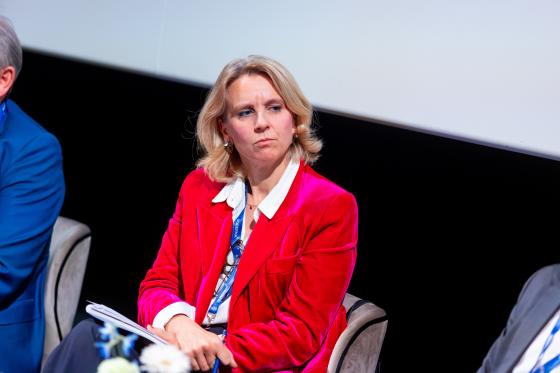
The discussion was moderated by Sandra Gobert (CEO of GUBERNA) with Jeroen Delvoie, Michaël Vanloubbeeck, Sofie Bracke, Johan Decuyper and Nicolas Daubies as panel members. The audience also had the opportunity to participate. This short article provides an overview of the key takeaways.
1. The need for a clear shareholder strategy
A first cornerstone for strong public governance is a clear shareholder strategy by the government. In the private sector, the role of the shareholder is often straightforward: creating (financial) value and managing risks. For the government, the situation is more complex. It combines financial and commercial interests with societal objectives, such as anchoring strategic infrastructure, maintaining the resilience of society, ensuring employment, and more.
As also highlighted in GUBERNA publications, the panelists pointed to the absence of such a shareholder strategy. In coalition agreements between parties, there is insufficient strategic reflection on the raison d’être of government shareholding. Best practice would be not only to develop such a strategy at every governance level but also to review it at the start of each legislative term. One consequence of the lack of a strategy is that derivative questions cannot be properly answered—for example, when special control rights (cf. ‘golden shares’) of the government as shareholder would be justified.
Nonetheless, it should not be forgotten that steps have indeed already been taken toward establishing a genuine shareholder strategy. The Federal Participations and Investment Company (SFPIM) has identified six strategic sectors in its strategy (cf. financial sector, aviation, life sciences, mobility, energy, and impact investing). The SFPIM has also worked on an overarching government shareholder strategy—not per individual participation—which can serve as a foundation.
Fundamentally, government participations are policy choices. It is crucial to make this process more rational by clarifying why participations are made, what the objectives are, and what types of state-owned enterprises are desired (cf. public service, financial return, anchoring), and to categorise them clearly on that basis. There is no need to reinvent the wheel each time; recommendations from the OECD can serve as a guide.
2. Clarity regarding the government’s role as shareholder
A second classic cornerstone of public governance is clarity about the government’s role as shareholder. As is well known, the government fulfills multiple roles with respect to its state-owned enterprises: shareholder (versus director), regulator, and supervisory authority (e.g., via a government commissioner). This naturally affects the role and functioning of the board of directors in which the government is represented.
The panel discussion made it clear that existing good governance practices should be sufficient to achieve clear role delineation. Importantly, these practices must be institutionalised to avoid reliance on the personal commitment of individuals.
Although there are differences between state-owned enterprises, the panelists noted general progress in the implementation of good governance principles. One panelist aptly stated that much progress has been made and that the glass should be seen as half full rather than half empty. This process takes time, as political balances must be broken. Moreover, politicians sometimes see good governance measures as a loss of power, rather than as interventions that contribute to the value creation of state-owned enterprises. Good governance is also a conditio sine qua non for the proper management of upcoming investments, particularly given the current geopolitical situation.
Steady progress in implementing good governance principles also means that suboptimal situations must sometimes be accepted as an intermediate step. During the panel, reference was made to the centralisation of government participations at the SFPIM. Most federal state-owned enterprises are now under the SFPIM, yet ironically, two ministers remain responsible for bpost and Proximus, respectively. In this situation, one may even question whether progress has truly been made. Where in the past a relationship agreement existed between two parties, there are now three (cf. the enterprise, the SFPIM, and the supervising minister).
This also indicates that the journey is far from over—it never truly ends—and further steps are needed. One such step mentioned during the panel is the legal status of state-owned enterprises. In line with OECD recommendations, standard corporate forms and processes should be used wherever possible. The government has a tendency to create sui generis structures, even though research shows that general corporate law is suitable for capturing the specificities of state-owned enterprises. Standard corporate law can accommodate public aspects, and where it cannot (cf. organisations carrying out policy tasks), the question arises whether the government has gone too far in distancing these public organisations.
3. Having the right people around the table
Finally, the composition of boards of directors was discussed as a major public governance challenge. It is crucial that directors are appointed based on the competencies and experience needed by the enterprise at a given moment, rather than purely political considerations.
The panel highlighted the selection process first and foremost. It was considered evident that this process must be professional. State-owned enterprises need strong boards of directors, although care must be taken to adapt private-sector principles appropriately. Politically appointed directors are not necessarily incompetent, and vice versa.
In recent years, the government has taken steps toward professionalising appointment procedures, but the process remains vulnerable to perceptions of political influence. Media reports on director appointments at bpost and Proximus attest to this. The government must also honor the commitments it has made.
Training is equally crucial to achieve a strong board composition. State-owned enterprises can facilitate this through a proper onboarding process, but directors themselves must also make efforts to familiarise themselves with the subject matter and understand their responsibilities. The chairperson also plays a role in reminding directors of their duties. One panelist suggested that the chair could report back to the political parties if a director is not fulfilling their responsibilities.
The panel also highlighted that, to get the right people around the table, the pool of potential directors must be expanded. Two factors hinder this. First, potential directors are discouraged by the periodic, highly publicised appointment carousel, where political compromises often delay decision-making. Few want to be part of such a ‘horse-racing’ process. Second, the proliferation of rules—bans on management companies, transparency requirements for remuneration and mandates, etc.—can be off-putting and are often unnecessary. These rules are relevant for cabinets and civil servants but not for individuals with specific private-sector profiles.
Conclusion
The panel discussion at the GUBERNA Festival of Governance showed that significant steps have been taken in recent years toward a mature governance culture in state-owned enterprises. The glass should be seen as half full rather than half empty. Yet it is not full, and further steps are needed:
Make the process of government participations more rational through a well-developed shareholder strategy
Let principles of good governance prevail over political balances
Bring the right people to the board table through an appropriate selection process, training, and by removing obstacles that make serving on a state-owned enterprise less attractive
One panelist summarised this by stating that the effectiveness of an enterprise must not suffer due to government participation.