How Governance Evolves Without Disruption - 30 Years GUBERNA - Innovative Governance
Paradoxically, thinking conservatively can be the first step toward true innovation. This panel discussion started just this way with the exposition of the standard definition of corporate governance, namely:
“The system of rules, bodies, and behaviors guiding company management and stakeholder relations”.
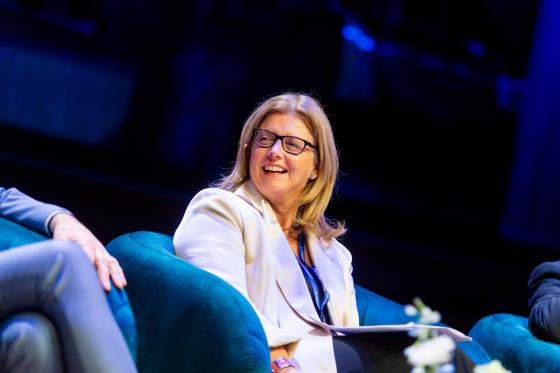
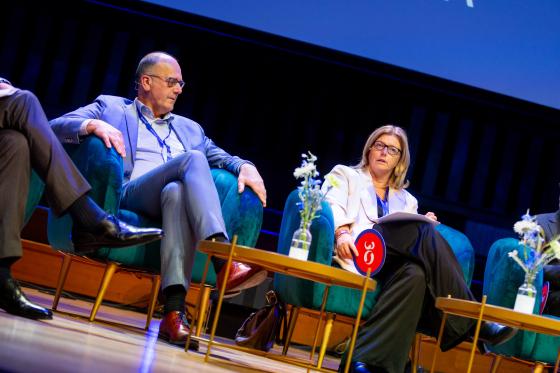
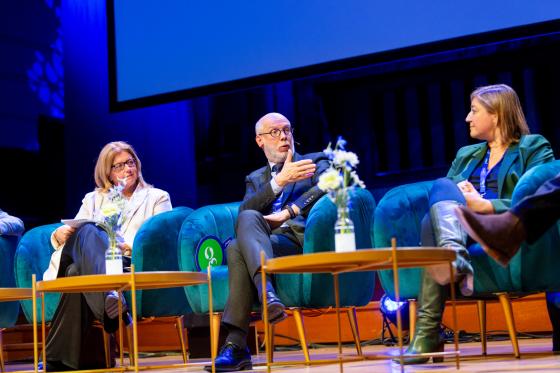
The discussion took place during the Festival of Governance, featuring the following participants: Kristof Macours, Bart De Smet, Elke Van Overwaele, Vanessa Vankerckhoven, and Paul Cornet De Ways Ruart, and was moderated by Olivier Hamoir.
The start of the debate centered on whether this way of thinking requires innovative or drastic changes at all. Maybe all is working just fine for the moment? However, maybe disruptive change is necessary in response to global trends such as technological advances (AI), China’s rise as a powerhouse, ESG priorities, social media disinformation, and increasing regulation.
Two perspectives readily emerged in the panel, and also in the crowd:
Incrementalists argue that governance evolves in phases and should focus on continuous improvement rather than radical disruption. They emphasize maintaining clear roles between boards and management, preserving the foundational value of checks and balances, and ensuring long-term vision. Innovation is welcome, but within a stable framework. Conversely,
Pro-innovation voices stress that accelerating change demands adaptability. Companies and their governance have to innovate to adapt to the environment and stay competitive. Boards should embrace risk-taking and innovative mindsets, especially in dynamic sectors like startups. Examples of governance evolution include scientific advisory boards complementing traditional boards, and initiatives like “next-generation boards” or youth councils providing fresh perspectives and trend insights. These mechanisms enrich decision-making without replacing core governance structures.
Overall however, the classic duality remains intact: boards ask the right questions; management does the right things. The panel was not really questioning that boards exist to set the strategy, monitor performance, and that management runs the operations of the business. Advisory committees, youth councils, and creative input mechanisms are useful, but they complement rather than replace the standard model. There is a great and enduring consensus that boards should keep innovation as a standing agenda item, but the power balances that are now commonplace and alleviate that sort of disruptive thinking don’t need the same innovation. So, it is clear that innovative thinking in the boardroom is not the same as disrupting the power balances. The latter is not being questioned.
Innovation in the boardroom
The panel members broadly agreed on the traditional governance framework, but maintained that innovation in working procedures, agendas, and processes is essential. This is not to change their core responsibilities, but to improve effectiveness. Key areas of innovation that were discussed include revisiting annual work plans to ensure strategic topics receive sufficient time, and experimenting with formats (e.g., offsites, walking discussions, and interactive tools like flipcharts and Post-its) to foster engagement.
Boards in highly regulated environments often struggle with overloaded agendas dominated by mandatory items, leaving little room for strategic debate. Solutions include restructuring agendas (e.g., placing strategic topics in the morning), creating ad hoc committees during crises, and introducing mentoring systems between executives and non-executive directors to strengthen collaboration. One panel member mentioned mentoring systems between executives and non-executive directors during offsite sessions with “walking meetings” around a lake. This injects human connection into governance while fostering trust and understanding. Other innovations involve clarifying discussion versus decision points, promoting active listening, and even adopting mediation techniques to ensure inclusive dialogue. Offsite sessions with external experts and talent-focused discussions are increasingly common to avoid repetitive, “copy-paste” meetings. Some panel members expressed their belief that individual directors really should be part of the firm, with badges, email address, and an office.
Family businesses often experiment with “shadow boards” to involve the next generation in governance culture. While useful for learning, their role should remain limited. Observers lack the same commitment as directors, which can disrupt board dynamics if overused. Careful, economic integration ensures they add value without undermining cohesion or decision-making authority.
The use of technology
The panel members and the crowd agreed on the necessity of using innovative tools and technologies to improve the decision quality. A panel member from the insurance industry highlighted the intersection of artificial and human thinking.
Artificial Intelligence is an extraordinary pattern seeker, capable of scanning millions of data points across academic research, social media, and global trends in seconds. Yet, its true potential emerges when combined with the collective wisdom of humans. One example illustrates this synergy: a company engaged over 2,000 employees worldwide to score 145 emerging trends by impact and timing. In parallel, an AI tool analyzed 140 million sources to identify patterns and anomalies. When the two perspectives were compared, the board discovered critical discrepancies: sometimes, trends employees considered low-impact, AI flagged as urgent. This was used in strategic exercises, but especially when new strategic decisions must be made.
However, even the most sophisticated models cannot predict the unpredictable. COVID and the stalled rise of autonomous cars remind us of that. AI unlocks hidden signals, but judgment remains the board’s most vital skill. Together, human experience and machine intelligence can transform governance from reactive to proactive.
Conclusion
Innovation is about disruption; it is the willingness to break the standard working procedures to create new environments and processes. Such disruption starts with the realization and acknowledgement that some chaos may arise before the newly set order. Of course, the perspective on the matter is not one sided; the majority supported disruption, while some favored caution. Proponents argue that entrepreneurship requires risk-taking and learning from failure, provided boards remain agile and ready to correct course quickly. Diversity in thinking is seen as essential to challenge traditional thinking and avoid group complacency. Others caution that challenging management and exploring multiple options is not true disruption but part of good governance. Disruption should not undermine trust, values, and alignment within the board, which are critical for implementing decisions effectively.